
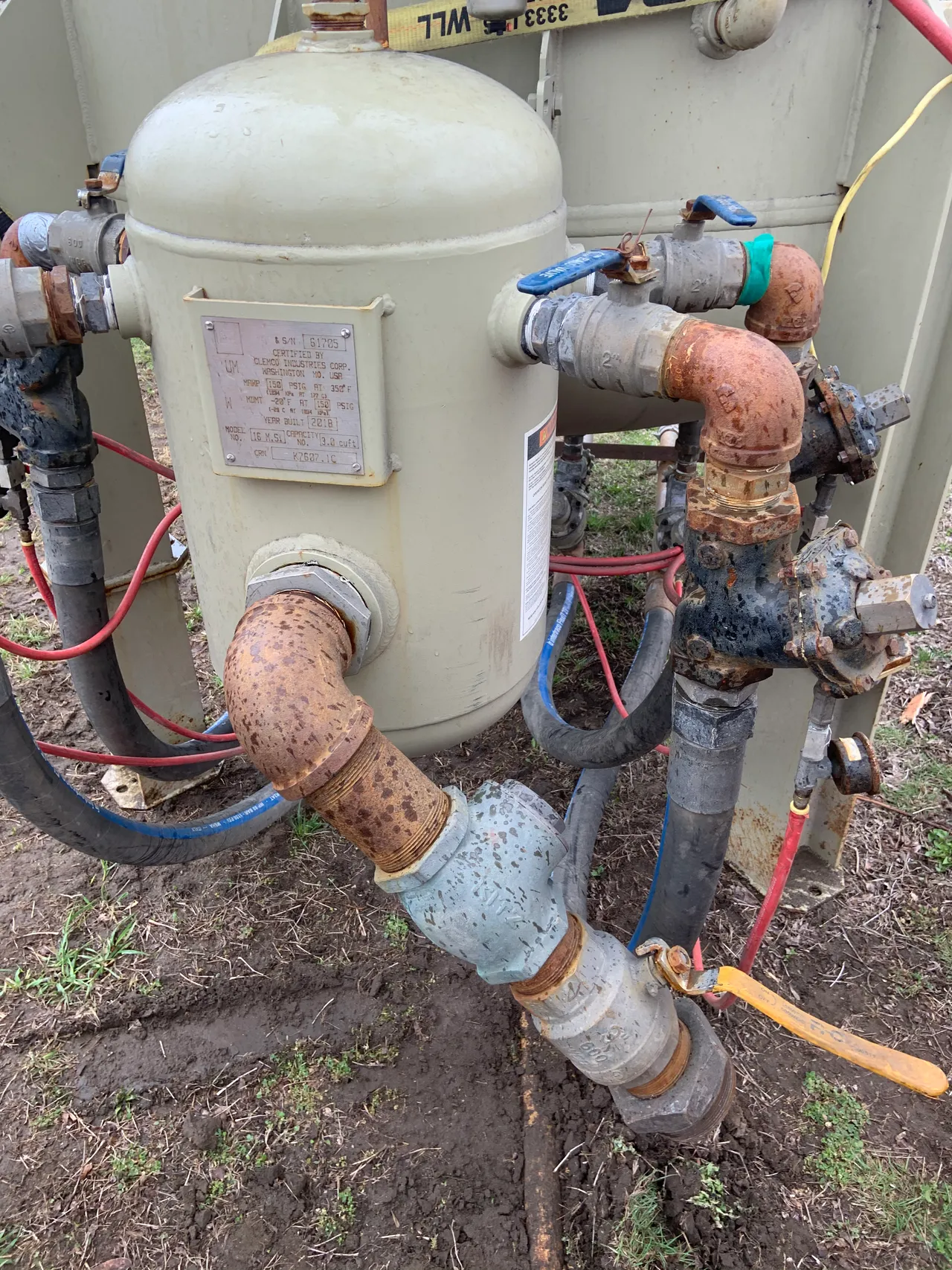
A complete guide to compressed air receivers in Québec
Purpose of this guide
You work in an industrial company in Québec and you are wondering:
- Am I allowed to install a compressed air tank myself?
- Do I need an RBQ licence or a CRN number?
- How often is maintenance or inspection required?
This guide explains, clearly and concretely, what Québec regulations (RBQ) say about the pressure installations used for compressed air.
Update, September 2026. Order in Council 1056-2026 (published 15 July 2026, in force 30 July 2026) adds paragraph 4 to RISP section 16: certain non-welded connection work on an air receiver (PMMP, volume and diameter under thresholds) no longer requires an installation permit. This guide has not been rewritten in full. Detail, verbatim excerpt and measures deferred to 2028: Order in Council 1056-2026: RBQ permit for a compressed-air receiver.
Disclaimer: This guide is provided for informational purposes only. It does not constitute official legal or technical advice. Any decision related to the installation, maintenance, or operation of pressure equipment must be validated by a qualified professional and comply with the requirements of the competent authorities. The author accepts no responsibility for any misinterpretation or incorrect application of the regulations cited. Refer to the laws and regulations in force in Québec and Canada for official legal obligations.
- Link to the RBQ regulations: Laws and regulations: pressure installations
- Link to the Québec piping installation code: BNQ 3650-900
What does the RBQ consider to be a receiver?
A compressed air tank is a device subject to the BNQ 3650-900 installation code and to the Pressure Installations Regulation (B-1.1, r. 6.1). These rules are intended to ensure the safety of workers and the public.
Legal reference, Section 2 of BNQ 3650-900: “This code applies to the installation of boilers, appliances, and pressure piping, both inside and outside buildings.”
Am I allowed to install a tank myself?
NO, unless you are:
- A company that holds a specific RBQ licence (installation or modification of pressure equipment), OR
- An employee of a company with an operator-user permit (permis d’exploitant-utilisateur) for internal work (e.g., a plant that maintains its own tanks).
Since 30 July 2026, an additional exemption exists for the non-welded connection of an air receiver under the thresholds in section 16, paragraph 4 (Order in Council 1056-2026). See Order in Council 1056-2026: RBQ permit for a compressed-air receiver.
Reference: Section 14 of Regulation B-1.1, r. 6.1 (and, since 30 July 2026, section 16, paragraph 4)
Can I install compressed air piping myself, without installing the air tank?
YES, if:
- The pipe diameter is less than or equal to 19 mm (¾ inch); or
- The work does not require welding (mechanical, threaded or compression fittings).
References:
- Section 4, paragraph 4: Piping ≤ 19 mm exempted
- Section 16, paragraph 2: Work without welding
Preventive maintenance and mandatory inspection
Even if you are exempt from the CRN, certain tanks must be inspected regularly.
Periodic inspection (Section 78, Table 1):
| Tank type | External inspection | Internal inspection |
|---|---|---|
| Compressed air receiver | Every 4 years | Not required |
Special cases:
- After a shutdown of more than one year or a change of use → mandatory inspection (Section 81).
- In case of relocation → mandatory internal/external inspection (Section 79).
These inspections must be carried out by a recognized person.
What is a CRN (Canadian Registration Number)?
The CRN is a registration number required for any pressure equipment (such as an air tank) manufactured or used in Canada.
It certifies that the tank:
- Was designed in accordance with Canadian standards (ASME, CSA B51, etc.);
- Has been evaluated and approved by a provincial authority (e.g., the RBQ in Québec).
A tank without a CRN may be rejected during an inspection, even if it is new.
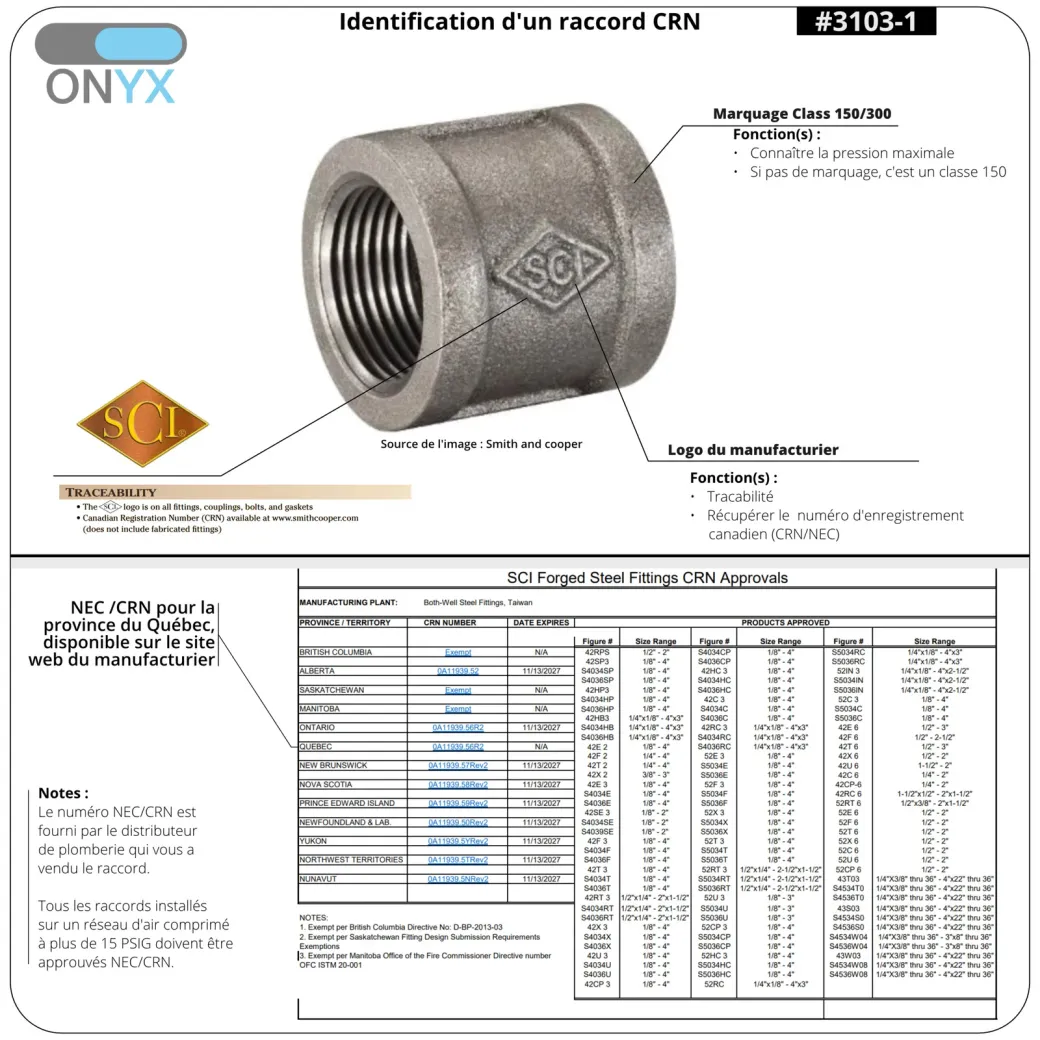
Does my tank need a CRN?
Yes, if it qualifies as an appliance under Section 2, Figure b).
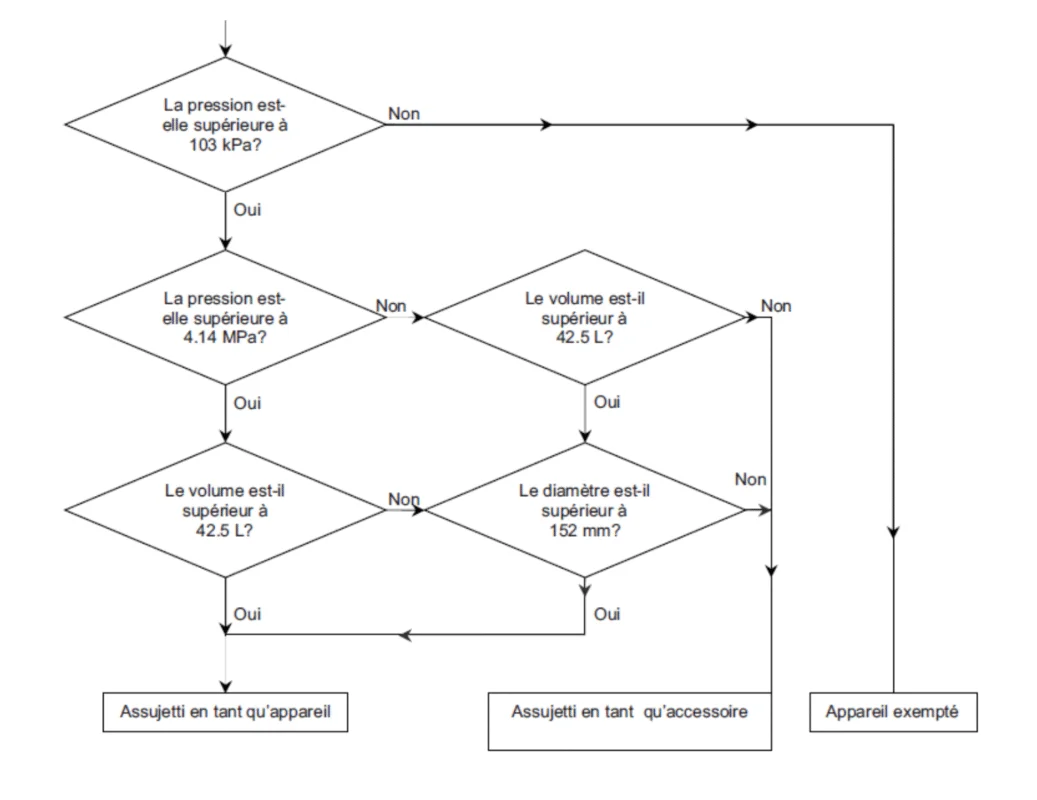
Link to the RBQ flowchart: RBQ flowchart (B-1.1, r. 6.1)
What is a “recognized person”?
This is an accredited inspector authorized by the Régie du bâtiment du Québec (RBQ) to perform regulatory inspections of pressure equipment.
Official list of recognized persons (as of August 8, 2025):
- RBQ inspectors
- Anchor Risk Solutions Corporation
- Aviva Canada
- B&M Risk Advice Inc.
- Bureau Veritas Inspections and Insurance Company
- Chubb Canada
- FM Global
- HSB Canada
- Intact Assurance
- Les consultants en soudage MEQUALTECH inc.
- Services Précis d’Opta
- TORNGATS Inspections Réglementaires inc.
Link to the RBQ’s updated list: Up-to-date list
Mandatory components on an air tank
According to the BNQ 3650-900 code, a tank must include:
- A readable pressure gauge (Section 11.2.1.1);
- A drain valve located at the lowest point (Section 11.2.2);
- Mechanical protection if moving parts are accessible, mesh or plate (Section 11.2.1.2).
CRN tank installation process
- Find an installer who holds an installer licence. List of licence holders
- Prior RBQ approval (Section 31).
- Declaration of works (Section 32), at least 30 days before the end of the work:
- Site address
- CRN number
- Valve adjustment pressure
- Technical specifications (volume, pressure, manufacturer)
- Verification of compliance at the end of the work.
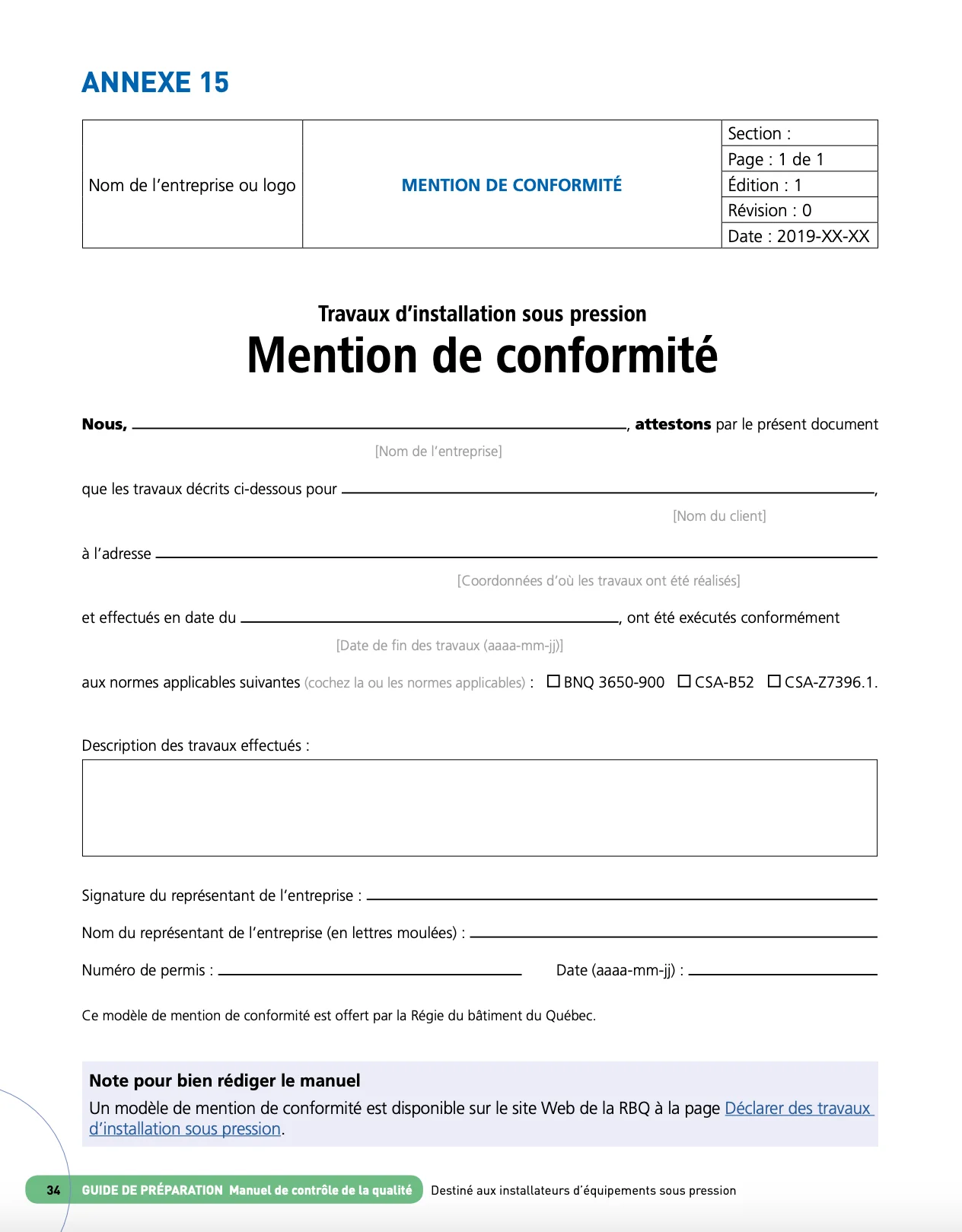
- Your installer sends you a statement of compliance attesting that the installation work complies with the applicable regulations.
Here is an excerpt from the Preparation guide which suggests a format for a statement of compliance.
Recommended training (BNQ 3650-900)
Train your staff to avoid costly mistakes:
- Interpretation of the BNQ code specific to your installation: 8 h
- Tank installation: 8 h
- RBQ compliance: 8 h
- Overview of the regulations applicable to your situation: 2 h
Schedule an exploratory meeting
Summary of key points
- The exemption in Section 71 applies only to inspection, not to the CRN.
- You generally must hold an RBQ licence to install a tank. Since 30 July 2026, the non-welded connection of an air receiver under the thresholds in section 16, paragraph 4 is exempt from an installation permit (Order in Council 1056-2026).
- Piping ≤ ¾ in. is not subject to pressure-installation regulations.
- An external inspection is required every 4 years for tanks that are subject to it.
- Relocating a tank = mandatory inspection.
- Any installation that is subject to the rules must be declared to the RBQ.
Free consultation
Our team will help you validate your project, choose a compliant tank, and commission it safely.
We offer you:
- A virtual or on-site meeting
- A quick, personalized quote
- Regulatory compliance support
Legal references
- BNQ 3650-900 code: Installation of boilers and pressure vessels.
- Regulation B-1.1, r. 6.1: Pressure installations in Québec (RBQ).
- Order in Council 1056-2026: RBQ permit, non-welded connection of an air receiver (in force 30 July 2026).
- RBQ website: Scope of intervention for pressure installations.
Author: Onyx M3 inc., experts in compressed air and RBQ compliance. Updated: September 2026.