
Compressed air flow units: SCFM, ACFM and FAD
In Canada, plant consumption is expressed in SCFM (CAGI ref.), compressor selection is done in FAD (ISO 1217), network sizing is done in ACFM (actual conditions) and instrumentation uses Nm³/h (DIN 1343). Using the wrong unit leads to poorly sized equipment.
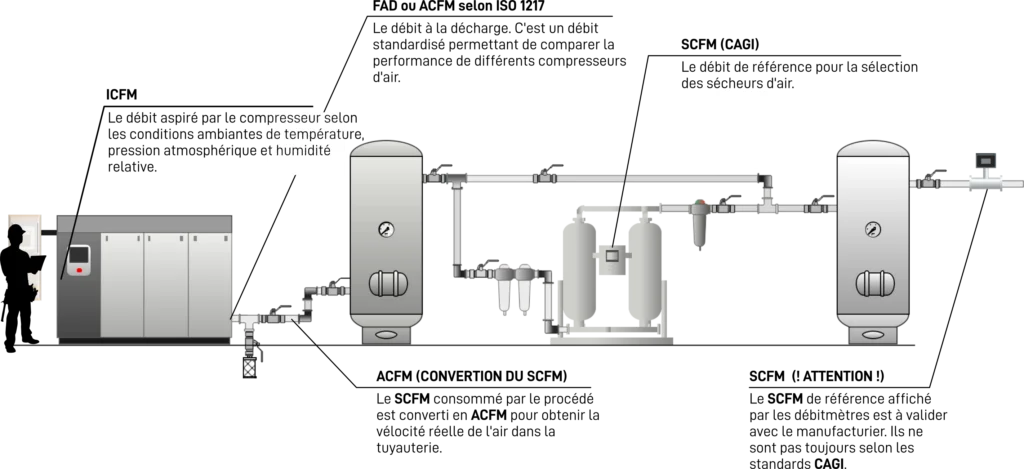
Flow unit definitions
| Unit | Definition | Main use (Canada) |
|---|---|---|
| SCFM | Standardized volumetric flow (CAGI ref.) | Plant consumption, energy audits, dryers, filters |
| ACFM | Actual volumetric flow at site conditions | Piping, velocities, pressure drops |
| ICFM | Flow at the compressor inlet at ambient conditions | Compare inlet and discharge flows (the inlet is sometimes higher than the discharge, e.g. centrifugal compressor) |
| FAD | Flow delivered by the compressor per the standardized ISO 1217 test | Compressor selection and comparison |
| Nm³/h | Normalized volumetric flow | Mass flow meters, instrumentation |
| L/s | Volumetric flow | Sensors, field measurements |
Usage note (Canada): The Nm³/min unit exists in the standards, but it is still rarely used in industrial compressed air in Canada. To avoid any confusion, it is not used in this article.
Reference conditions
FAD: ISO 1217
- Temperature: 20 °C (68 °F)
- Pressure: 1 bar abs / 100 kPa (14.5 psia)
- Humidity: 0 % RH
SCFM: CAGI ref.
- Temperature: 20 °C (68 °F)
- Pressure: 1 bar abs / 100 kPa (14.5 psia)
- Humidity: 0 % RH
Nm³/h (and Nm³/min): DIN 1343
- Temperature: 0 °C
- Pressure: 101.3 kPa abs
- Humidity: 0 % RH
Important (instrumentation): some mass flow meters can display normalized flow in Nm³/h or Nm³/min, both based on DIN 1343. Even though Nm³/min is not used in this article, it refers to exactly the same reference conditions.
Common equivalences (Canada)
| Imperial unit | Normalized equivalent |
|---|---|
| 1 SCFM | 1.70 Nm³/h |
| 1 SCFM | 0.472 L/s |
Usage rule
- SCFM → express the air demand
- FAD → select a compressor
- ACFM (actual) → size the network
- Nm³/h → instrumentation and metric comparisons
Which flow rate to use to determine my plant’s consumption?
Flow rate to use: SCFM (or normalized Nm³/h).
Example
- Zone A: 250 SCFM (425 Nm³/h)
- Zone B: 180 SCFM (306 Nm³/h)
- Zone C: 120 SCFM (204 Nm³/h)
Total consumption = 550 SCFM (935 Nm³/h)
SCFM flow is a standardized flow: it becomes the reference that ensures consistency across the various process specifications.
Which unit should dryer or filter selection be based on?
Flow rate to use: SCFM.
Example
- Maximum plant demand: 550 SCFM
- Selected dryer: ≥ 550 SCFM (≈ 935 Nm³/h)
Which unit to size a compressor?
Unit to use: FAD (ISO 1217 / CAGI).
Example
- Plant demand: 550 SCFM
- Required compressor: FAD ≥ 550 SCFM (+ margin)
SCFM → ACFM conversion
ACFM = SCFM × (Pstd / Pact) × (Tact / Tstd)
- Pstd = 14.5 psia
- Pact = absolute pressure at the point considered (psig + 14.5)
- Tstd = 68 °F + 459.67
- Tact = actual temperature (°F + 459.67)
ACFM is an actual flow: its value depends on where in the system it is measured. For 550 SCFM:
At the compressor inlet (ambient air)
- Pressure ≈ atmospheric (≈ 14.5 psia) · temperature 90 °F
- ACFM ≈ 573
The hotter the intake air (and the more humid), the more it expands: you need more ACFM (actual volume) to deliver a given SCFM; i.e. at the inlet, ACFM exceeds SCFM, and the gap widens with temperature. This is why a compressor delivers fewer SCFM in hot weather; this flow is compared against FAD to size the air intake.
In the line, at line pressure
- Line pressure 110 psig (124.5 psia) · temperature 90 °F
- ACFM ≈ 67
Once compressed to 110 psig, the same mass flow occupies ~8.6× less actual volume. This reduced flow is what travels through the distribution piping and is used to compute velocities and pressure drops downstream.
References
- CAGI: Performance Verification Program
- ISO 1217: Compressor performance testing
- DIN 1343: Reference conditions (Nm³/h, Nm³/min)
- Compressed Air Best Practices
- Compressed Air Challenge